
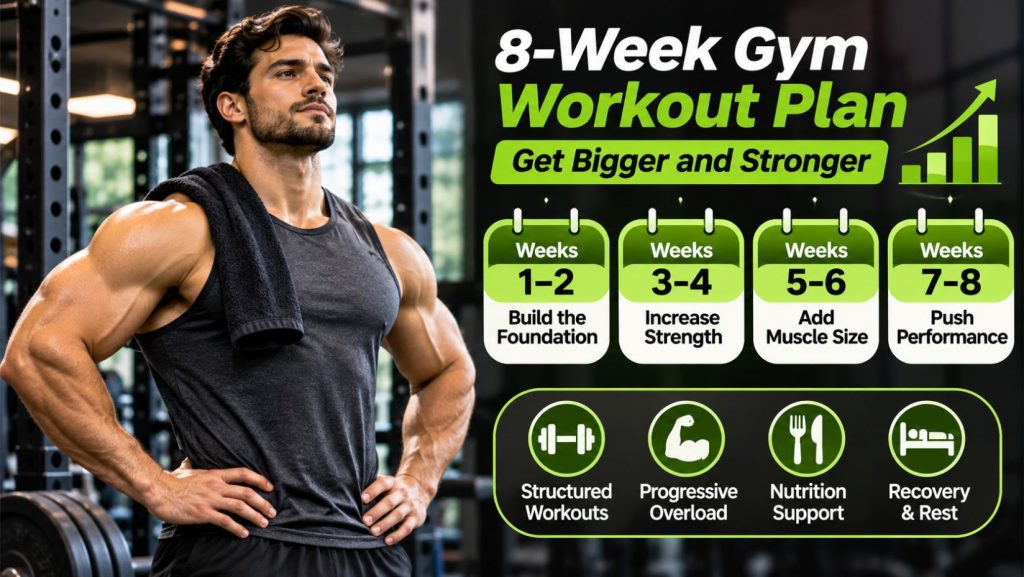
Building muscle and increasing strength require more than lifting heavy weights. A successful fitness program combines structured workouts, progressive overload, balanced nutrition, and adequate recovery.
This 8 week gym workout plan provides a practical training schedule for adults who want to develop muscle, improve strength, and build consistent exercise habits.
Whether you are relatively new to weight training or returning to the gym after a break, this program can help you establish a stronger fitness foundation.
The plan includes four weekly resistance-training sessions, with additional time for recovery and optional light activity.
Why Follow an 8-Week Gym Workout Plan?
Following a structured workout plan helps you track progress instead of choosing random exercises each time you visit the gym.
An effective training program offers several advantages:
- Muscle development: Resistance training stimulates muscles to adapt and grow.
- Strength improvement: Repeated practice of compound movements can improve strength and coordination.
- Workout consistency: A weekly schedule makes exercise easier to organize.
- Progress tracking: Recording sets, repetitions, and weights helps measure improvement.
- Balanced development: Training different muscle groups supports overall fitness.
Eight weeks can be enough to notice improvements in exercise technique, training performance, and strength. Visible muscle growth varies depending on experience, nutrition, sleep, and individual factors.
Your Weekly Gym Workout Schedule
This program follows a four-day upper-body and lower-body split.
| Day | Workout |
|---|---|
| Monday | Upper Body A |
| Tuesday | Lower Body A |
| Wednesday | Rest or light walking |
| Thursday | Upper Body B |
| Friday | Lower Body B |
| Saturday | Optional light cardio or mobility |
| Sunday | Rest and recovery |
Allow at least one recovery day between sessions targeting the same muscle groups.
Beginners who find four weekly sessions too demanding can start with fewer workouts and gradually increase their training frequency.
Day 1: Upper Body A – Chest, Back and Arms
This workout focuses on major upper-body muscles through pressing and pulling movements.
| Exercise | Sets | Repetitions |
|---|---|---|
| Barbell Bench Press | 3 | 6–10 |
| Lat Pulldown | 3 | 8–12 |
| Seated Dumbbell Shoulder Press | 2 | 8–12 |
| Seated Cable Row | 3 | 8–12 |
| Dumbbell Biceps Curl | 2 | 10–15 |
| Triceps Pushdown | 2 | 10–15 |
Start with a weight you can control throughout the entire movement.
Avoid sacrificing technique simply to lift heavier weights.
Day 2: Lower Body A – Legs and Core
Training the lower body helps develop strength in the quadriceps, hamstrings, glutes, and supporting muscles.
| Exercise | Sets | Repetitions |
|---|---|---|
| Barbell Squat or Goblet Squat | 3 | 6–10 |
| Romanian Deadlift | 3 | 8–10 |
| Leg Press | 2 | 10–12 |
| Standing Calf Raise | 3 | 12–15 |
| Plank | 3 | 20–45 seconds |
Focus on controlled movements and a comfortable range of motion.
If you are unfamiliar with squats or Romanian deadlifts, ask a qualified trainer to demonstrate the correct technique.
Day 3: Rest and Active Recovery
Recovery is an essential part of building muscle.
During rest days, your body adapts to the training performed during previous sessions.
Consider activities such as:
- Walking at a comfortable pace
- Gentle stretching
- Light cycling
- Mobility exercises
- Relaxation and adequate sleep
Avoid turning every rest day into another demanding workout.
Day 4: Upper Body B – Back, Shoulders and Chest
The second upper-body workout uses different movements to provide balanced training.
| Exercise | Sets | Repetitions |
|---|---|---|
| Incline Dumbbell Bench Press | 3 | 8–12 |
| Assisted Pull-Up or Lat Pulldown | 3 | 8–12 |
| Chest-Supported Row | 3 | 8–12 |
| Dumbbell Lateral Raise | 2 | 12–15 |
| Hammer Curl | 2 | 10–15 |
| Overhead Triceps Extension | 2 | 10–15 |
Maintain a controlled lifting tempo and avoid swinging weights to complete repetitions.
Day 5: Lower Body B – Strength and Stability
The final resistance-training session of the week targets the legs, glutes, and core.
| Exercise | Sets | Repetitions |
|---|---|---|
| Trap-Bar Deadlift or Hip Thrust | 3 | 5–8 |
| Bulgarian Split Squat | 2 | 8–10 per leg |
| Seated Leg Curl | 3 | 10–12 |
| Leg Extension | 2 | 10–12 |
| Seated Calf Raise | 3 | 12–15 |
| Dead Bug | 3 | 8–12 per side |
Choose exercise variations that suit your mobility, experience, and available equipment.
How to Progress Through the 8 Weeks
Progressive overload means gradually increasing the challenge placed on your muscles as your strength improves.
However, increasing weight every session is not necessary.
Weeks 1–2: Build Your Foundation
During the first two weeks, concentrate on exercise technique and selecting appropriate weights.
- Learn correct movement patterns.
- Use manageable resistance.
- Leave approximately two or three repetitions in reserve.
- Record your exercises, weights, and repetitions.
- Prioritize consistency over intensity.
If needed, complete only two sets of each exercise while adjusting to the program.
Weeks 3–4: Improve Training Performance
Once you feel comfortable with the exercises, begin increasing the training challenge gradually.
You can do this by adding repetitions, improving movement control, or slightly increasing resistance.
For example, if your bench press target is 6–10 repetitions, aim to perform more repetitions with good technique before adding weight.
Weeks 5–6: Focus on Muscle Development
Continue working within the prescribed repetition ranges.
For muscle-building exercises, select weights that make the final few repetitions challenging without causing your technique to deteriorate.
Avoid adding unnecessary sets if you are already experiencing persistent fatigue or excessive soreness.
Weeks 7–8: Consolidate Your Progress
During the final two weeks, aim to improve on your earlier performance.
You might lift a slightly heavier weight, perform additional controlled repetitions, or demonstrate better exercise technique.
If you feel unusually fatigued, reduce your training volume rather than pushing through exhaustion.
At the end of week eight, review your progress and decide whether to repeat the program or move to a new training phase.
The Importance of Nutrition for Muscle Growth
Exercise provides the stimulus for muscle development, but adequate nutrition helps support recovery and adaptation.
Eat Enough Protein
Protein supplies amino acids needed for muscle repair and growth.
Useful protein sources include:
- Chicken and turkey
- Fish
- Eggs
- Milk and yogurt
- Beans and lentils
- Tofu and other soy foods
For many healthy adults who regularly perform resistance training, approximately 1.4–2.0 grams of protein per kilogram of body weight per day can support muscle development.
Individual requirements may vary, especially for people with medical conditions.
Include Carbohydrates
Carbohydrates help fuel resistance-training sessions and replenish muscle glycogen.
Choose foods such as oats, rice, potatoes, fruit, and whole-grain bread.
Very restrictive diets can make it harder to maintain training performance.
Include Healthy Fats
Healthy fats contribute to overall nutrition.
Examples include olive oil, nuts, seeds, avocados, and oily fish.
Consume Adequate Calories
Building muscle requires sufficient energy.
Some individuals may benefit from a modest calorie surplus, while beginners may improve body composition without deliberately increasing calorie intake.
Avoid excessive bulking or rapid weight-gain strategies.
Hydration and Workout Performance
Hydration supports normal physical function and exercise performance.
Drink fluids regularly throughout the day and adjust your intake according to activity intensity, temperature, and sweat loss.
Water is usually sufficient for ordinary gym sessions.
Longer or particularly demanding workouts may require additional hydration planning.
How Much Rest Do You Need Between Sets?
Rest periods depend on the exercise and training objective.
For challenging compound movements such as squats and bench presses, resting approximately two to three minutes can help maintain performance.
For smaller isolation exercises such as biceps curls or lateral raises, one to two minutes may be sufficient.
Take longer if necessary to recover your breathing and maintain good technique.
Common Mistakes to Avoid During Your 8-Week Workout Plan
Lifting Too Heavy Too Soon
Using excessive weight can compromise technique and increase injury risk.
Choose manageable resistance and progress gradually.
Ignoring Recovery
Training intensely without sufficient rest can lead to fatigue and reduced performance.
Include regular rest days and aim for adequate sleep.
Changing Exercises Too Frequently
Constantly switching exercises makes progress harder to measure.
Keep your main movements consistent throughout the program.
Neglecting Nutrition
Inadequate energy or protein intake may limit recovery and muscle development.
Support your workouts with balanced meals.
Expecting Instant Results
Strength and muscle development take time.
Focus on sustainable improvements rather than unrealistic transformations.
How to Track Your Progress
A training journal can help you understand how your body responds to exercise.
Record the following information:
- Exercises performed
- Weights lifted
- Sets and repetitions
- Energy levels
- Recovery and soreness
- Weekly training consistency
You may also track body measurements or progress photographs if these methods are comfortable and useful for you.
Remember that strength improvements are meaningful even when physical appearance changes slowly.
Who Should Modify This Workout Plan?
This program is intended as general guidance for healthy adults.
People with cardiovascular conditions, recent injuries, joint problems, pregnancy-related exercise considerations, or other relevant health concerns may need an individualized training plan.
Beginners should learn safe lifting techniques and consider working with a qualified fitness professional.
Stop exercising and seek medical attention if you experience chest pain, fainting, severe dizziness, or other concerning symptoms.
Conclusion
An 8 week gym workout plan can provide a practical foundation for developing strength, building muscle, and improving workout consistency.
By following a balanced upper-body and lower-body routine, gradually increasing training demands, eating nutritious meals, and allowing sufficient recovery, you can make meaningful progress toward your fitness goals.
The most effective workout program is one that matches your experience, supports your health, and remains sustainable beyond the first eight weeks.
Frequently Asked Questions
Can I build muscle in eight weeks?
Yes. Some people can develop measurable muscle growth within eight weeks, although results vary. Beginners may also experience noticeable improvements in strength and coordination.
Is four days a week enough to build muscle?
Four well-structured resistance-training sessions per week can be sufficient for muscle growth and strength development when combined with appropriate recovery and nutrition.
Should beginners follow this workout plan?
Beginners can use a modified version with lighter weights, fewer sets, and professional guidance when necessary.
Do I need protein supplements to build muscle?
No. Protein requirements can often be met through ordinary foods. Supplements may be convenient but are not essential for everyone.
Should I lift heavier weights every week?
Not necessarily. Progress can also come from performing more repetitions, improving technique, or increasing training consistency.
What happens after the eight weeks?
Review your progress, adjust your training goals, and continue with a suitable program. You can repeat the routine with updated weights or move to another structured training phase.
Suggested References
- American College of Sports Medicine – Resistance Training and Exercise Guidance
- World Health Organization – Physical Activity Guidelines
- International Society of Sports Nutrition – Position Stand on Protein and Exercise
- Centers for Disease Control and Prevention – Physical Activity Basics for Adults
Medical disclaimer: This article provides general fitness education and is not a substitute for individualized medical or professional training advice.