
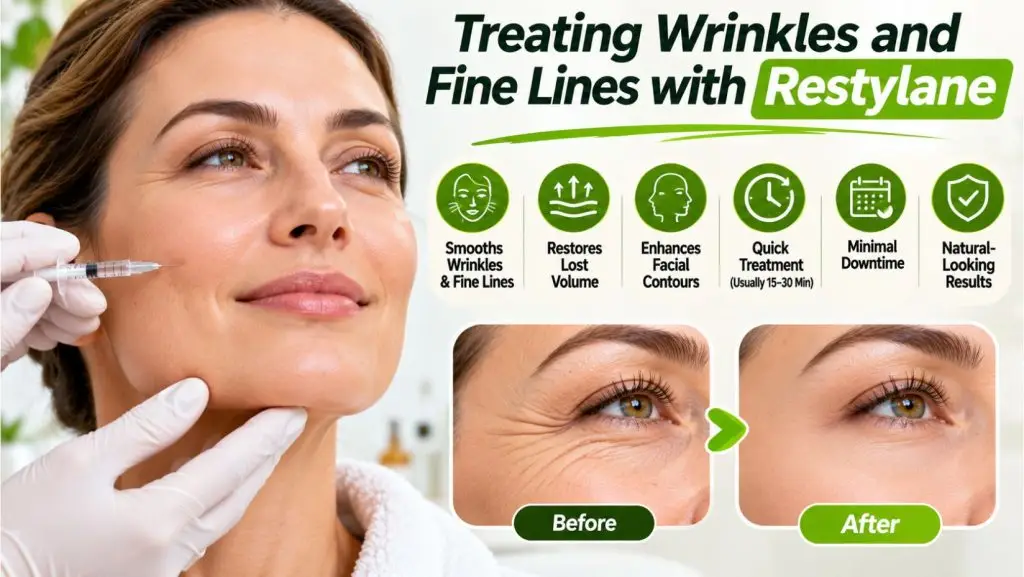
Wrinkles and fine lines are natural features of aging. Over time, changes in collagen, elastin, facial fat, and skin hydration can affect facial appearance.
For people interested in cosmetic treatments, Restylane for wrinkles is one of several injectable dermal filler options that may help improve the appearance of selected facial lines and areas affected by volume loss.
Restylane is a family of hyaluronic acid-based dermal fillers used for specific cosmetic indications. Depending on the product and the area being treated, these fillers may help restore volume, soften certain wrinkles, and improve facial contours.
However, injectable fillers are medical procedures with potential risks, including rare but serious complications.
This guide explains how Restylane works, what it may treat, expected results, possible side effects, and important safety considerations.
What Is Restylane?
Restylane is a brand of injectable dermal fillers made primarily from hyaluronic acid.
Hyaluronic acid is a substance naturally present in the body, including the skin and connective tissues.
It has the ability to bind water and contributes to tissue hydration and volume.
Restylane products contain specially formulated hyaluronic acid gels designed for injection into particular facial areas.
Different products within the Restylane family have different characteristics and approved uses.
The appropriate product depends on the treatment area, the patient’s anatomy, and the clinician’s assessment.
How Does Restylane Work for Wrinkles and Fine Lines?
Hyaluronic acid fillers work primarily by adding volume to the tissues where they are injected.
This added volume can help reduce the appearance of certain facial folds and wrinkles.
For example, some wrinkles become more visible as the face loses volume with age.
A suitable filler may help restore support beneath the skin and soften the appearance of these lines.
However, Restylane does not permanently reverse skin aging or eliminate every type of wrinkle.
Fine lines caused primarily by repeated facial muscle movement may respond differently from wrinkles associated with volume loss.
Which Facial Areas Can Restylane Treat?
Different Restylane formulations are approved for different treatment areas.
Nasolabial Folds
Nasolabial folds are the lines extending from the sides of the nose toward the corners of the mouth.
Certain Restylane products are approved to correct moderate to severe facial wrinkles and folds, including nasolabial folds.
Lips and Perioral Lines
Some Restylane formulations are used for lip augmentation or the treatment of selected wrinkles around the mouth.
The exact approved indications vary by product and jurisdiction.
Cheeks and Midface
Certain products within the Restylane family are designed to restore volume or improve contours in the cheeks and midface.
Under-Eye Hollows
Specific Restylane formulations may be approved for infraorbital hollowing in eligible adults.
The under-eye region is anatomically complex and requires particularly careful patient selection and experienced treatment.
Other Facial Areas
A clinician may discuss additional treatment areas depending on the available products and local regulatory approvals.
Not every Restylane product is appropriate for every facial area.
Potential Benefits of Restylane Treatment
Restylane may offer several cosmetic benefits when used appropriately.
1. Softening Certain Facial Wrinkles
Hyaluronic acid fillers can reduce the appearance of selected wrinkles and folds by providing additional tissue volume.
2. Restoring Lost Facial Volume
Some formulations can help address age-related facial volume loss.
3. Improving Facial Contours
Certain products may be used to enhance or restore specific facial contours.
4. Providing Results Without Surgery
Dermal filler treatment does not usually require surgical incisions.
However, it remains an invasive medical procedure involving injections.
5. Offering Temporary Results
Hyaluronic acid fillers are not permanent.
Their effects gradually diminish over time, although duration varies by formulation, treatment area, and individual factors.
Restylane vs. Botox: What Is the Difference?
Restylane and Botox are different types of injectable cosmetic treatments.
| Feature | Restylane | Botox |
|---|---|---|
| Main ingredient | Hyaluronic acid | Botulinum toxin type A |
| Primary action | Adds tissue volume | Temporarily reduces targeted muscle activity |
| Common use | Selected wrinkles, folds, and volume loss | Certain expression-related wrinkles |
| Results | Often visible soon after treatment | Usually develop over several days |
| Duration | Varies by product and area | Often several months |
Some people may benefit from different treatments for different concerns.
A qualified clinician can explain which approach is appropriate.
What Happens During a Restylane Treatment?
The treatment process generally begins with a medical consultation.
Step 1: Consultation
The clinician evaluates your facial anatomy, treatment goals, medical history, and suitability for injectable fillers.
You should disclose medications, allergies, previous cosmetic procedures, and relevant medical conditions.
Step 2: Treatment Planning
The clinician identifies the intended injection areas and selects an appropriate product.
Step 3: Skin Preparation
The treatment area is cleaned.
A topical anesthetic or other pain-management method may be used when appropriate.
Some Restylane products contain lidocaine to reduce injection discomfort.
Step 4: Injection
The clinician injects the filler using an appropriate technique and instrument.
The amount and placement depend on the product and treatment plan.
Step 5: Post-Treatment Assessment
The clinician evaluates the treated area and provides aftercare instructions.
The procedure may be relatively brief, but appointment duration varies.
How Long Does Restylane Last?
Restylane results are temporary, but the duration varies considerably.
Some formulations may provide visible effects for several months, while others may last longer in particular treatment areas.
Factors affecting duration include:
- The specific Restylane product
- Treatment location
- Amount of filler used
- Individual metabolism and tissue characteristics
- Facial movement
- Treatment technique
Avoid relying on a single advertised duration for every Restylane formulation.
Your clinician should explain the expected duration for the specific product being considered.
Is Restylane Treatment Painful?
Patients may experience discomfort during filler injections.
The level of discomfort varies according to the treatment area, individual sensitivity, and pain-management methods.
Topical anesthetics and lidocaine-containing formulations may help reduce discomfort.
Temporary tenderness or swelling may occur afterward.
Common Side Effects of Restylane
Common injection-related side effects may include:
- Redness
- Swelling
- Tenderness
- Bruising
- Pain
- Itching
- Temporary firmness or small lumps
These effects are often temporary, but their duration varies.
Persistent or worsening symptoms should be assessed by the treating clinician.
Serious Risks of Restylane Dermal Fillers
Although uncommon, serious complications can occur.
Accidental Injection Into a Blood Vessel
One of the most important risks of dermal fillers is unintended injection into a blood vessel.
This can interrupt blood supply and cause tissue injury.
In rare cases, vascular complications can result in skin necrosis, vision loss, blindness, or stroke.
Infection
Any injection procedure carries a risk of infection.
Allergic or Inflammatory Reactions
Some individuals may develop hypersensitivity reactions, delayed inflammation, or nodules.
Filler Migration or Irregularities
Filler may produce uneven contours, visible lumps, or other cosmetic complications.
Delayed Reactions
Inflammation or other adverse effects may occur after the initial treatment period.
Emergency warning: Sudden severe pain, skin blanching or unusual discoloration, visual changes, or stroke-like symptoms during or after filler injection require immediate emergency medical evaluation.
Who Should Avoid or Delay Restylane Treatment?
Dermal fillers are not suitable for everyone.
Treatment may need to be avoided or postponed in people with:
- Certain severe allergies
- Known hypersensitivity to relevant product components
- Active infection or inflammation near the injection site
- Specific bleeding or medical conditions requiring additional assessment
Safety during pregnancy and breastfeeding has not been adequately established for many dermal filler products.
A qualified healthcare professional should review individual risks and the product’s official prescribing information.
Restylane Aftercare Tips
Your treating clinician should provide specific aftercare instructions.
General recommendations may include:
Avoid Unnecessary Pressure
Do not aggressively massage or manipulate the treated area unless your clinician instructs you to do so.
Follow Activity Guidance
Your clinician may recommend temporarily limiting strenuous exercise or exposure to excessive heat, depending on the treatment.
Monitor for Complications
Pay attention to unusual pain, increasing swelling, skin color changes, or visual symptoms.
Attend Follow-Up Appointments
Follow-up visits allow the clinician to assess results and identify any concerns.
Do not attempt to manage suspected filler complications at home.
How Much Does Restylane Cost?
Restylane treatment costs vary according to location, provider qualifications, product selection, and the amount of filler required.
Additional factors include the complexity of the treatment and whether follow-up appointments are included.
Because cosmetic filler prices change over time and vary by market, patients should request an individualized estimate from a licensed provider.
Avoid selecting an injector solely because they offer the lowest price.
How to Choose a Qualified Restylane Provider
Choosing an appropriately trained healthcare professional is one of the most important safety decisions.
Look for a provider who:
- Is legally qualified to perform injectable cosmetic procedures
- Has specific training in facial anatomy and dermal fillers
- Uses authentic, appropriately sourced products
- Explains risks and realistic outcomes
- Has a clear emergency complication-management plan
- Provides appropriate follow-up care
Ask which exact Restylane product will be used and whether it is approved for the intended treatment area in your country.
Are Restylane Results Natural-Looking?
Some patients achieve subtle cosmetic changes that preserve their existing facial appearance.
However, results depend on the product, injection technique, treatment volume, and individual anatomy.
Excessive filler or unsuitable placement can produce an unnatural appearance or other complications.
Discuss realistic expectations with your clinician before treatment.
Can Restylane Be Reversed?
Hyaluronic acid fillers can sometimes be broken down using an enzyme called hyaluronidase.
However, reversal is not guaranteed to correct every complication, and it may require additional medical treatment.
The use of hyaluronidase also carries its own risks and should be managed by an appropriately qualified clinician.
Alternatives to Restylane for Fine Lines
Other treatments may be appropriate depending on the cause and location of wrinkles.
Topical Retinoids
Certain topical retinoids may improve fine lines associated with photoaging over time.
Sunscreen
Broad-spectrum sunscreen helps reduce further ultraviolet-related skin damage.
Botulinum Toxin Injections
These may be appropriate for selected expression-related wrinkles.
Laser and Light-Based Treatments
Some procedures target skin texture, pigmentation, or signs of photoaging.
Other Dermal Fillers
Different filler formulations may be suitable for particular treatment goals.
Every option has benefits, limitations, and risks.
Conclusion
Restylane for wrinkles is an established category of hyaluronic acid dermal filler treatment that may help soften selected facial folds, restore volume, and improve certain facial contours.
However, Restylane is not a universal solution for every fine line, and treatment outcomes vary.
Injectable fillers carry medical risks, including rare but serious vascular complications.
Anyone considering Restylane should consult an appropriately qualified healthcare professional, discuss realistic expectations, and understand the benefits and risks of the specific product being used.
Frequently Asked Questions
Is Restylane effective for wrinkles?
Certain Restylane formulations are approved for correcting selected facial wrinkles and folds. Effectiveness depends on the product, treatment area, and individual characteristics.
How long do Restylane results last?
Results vary by product and treatment location. Your clinician can explain the expected duration for your specific treatment.
Is Restylane better than Botox?
Neither is universally better. Restylane adds volume, while Botox reduces targeted muscle activity. They address different cosmetic concerns.
Can Restylane cause serious side effects?
Yes. Rare complications include vascular blockage, tissue injury, blindness, and stroke. Treatment should be performed by a qualified healthcare professional.
Is Restylane permanent?
No. Restylane is generally considered a temporary hyaluronic acid filler, although its effects and residual material may persist for varying periods.
Can Restylane be dissolved?
Hyaluronic acid fillers can sometimes be dissolved using hyaluronidase, but this does not guarantee complete reversal of every adverse effect.
How do I know if Restylane is right for me?
A qualified clinician can evaluate your anatomy, medical history, treatment goals, and potential risks.
Medical References
- U.S. FDA – Dermal Fillers
- U.S. FDA – Dermal Filler Safety
- American Academy of Dermatology – Fillers
- Restylane – Official Product Information
Medical disclaimer: This article is for general educational purposes and does not replace individualized medical advice. Injectable dermal fillers should only be administered by appropriately qualified healthcare professionals.