
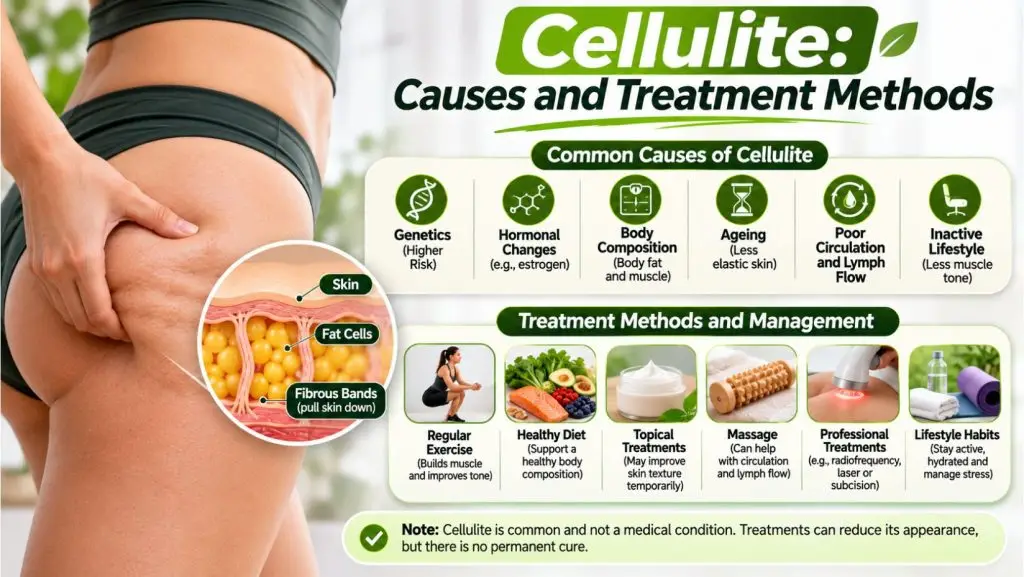
Cellulite is a common skin condition that causes a dimpled or uneven appearance, often described as resembling orange peel or cottage cheese. It most frequently appears on the thighs, buttocks, hips, and abdomen.
Although cellulite is sometimes viewed as a cosmetic concern, it is a normal and harmless variation in skin appearance. People of different body sizes and fitness levels can develop cellulite.
Understanding cellulite causes and treatment options can help you make informed decisions about skincare, lifestyle habits, and cosmetic procedures.
This article explains what cellulite is, why it develops, which treatments may improve its appearance, and what results you can realistically expect.
What Is Cellulite?
Cellulite occurs when underlying fat tissue and fibrous connective bands interact in a way that creates visible dimples on the skin’s surface.
Fibrous bands connect the skin to deeper tissues. In areas affected by cellulite, these bands may pull the skin downward while surrounding fat pushes upward.
This difference in tissue structure produces the characteristic uneven appearance.
Cellulite is not an infection, and it is different from cellulitis, a potentially serious bacterial skin infection.
It is also not necessarily a sign of poor health or excess body weight.
What Causes Cellulite?
The exact mechanisms behind cellulite are complex, and researchers continue to investigate the factors involved.
Several characteristics appear to influence its development.
1. Genetics
Genetics plays an important role in the likelihood of developing cellulite.
Inherited differences in skin structure, connective tissue, and fat distribution may influence how visible cellulite becomes.
If close family members have cellulite, you may be more likely to develop it.
2. Hormonal Influences
Cellulite is particularly common in women, and hormonal factors may contribute to differences in fat distribution and connective tissue structure.
Estrogen is often discussed as a possible influence, although the precise relationship between hormones and cellulite is not fully understood.
3. Skin Structure and Connective Tissue
The arrangement of fibrous connective bands beneath the skin is central to cellulite formation.
These bands can create tension that pulls parts of the skin inward, resulting in dimples.
4. Age-Related Changes
As people age, skin may become thinner and lose some elasticity.
These changes can make underlying tissue irregularities more visible.
5. Body Fat Distribution
The amount and distribution of subcutaneous fat may affect cellulite visibility.
However, cellulite also occurs in people with relatively low body fat.
6. Changes in Skin Elasticity
Collagen and elastin help maintain skin structure and flexibility.
Changes in these components may influence the appearance of cellulite over time.
7. Lifestyle Factors
Physical activity, nutrition, and weight changes can affect body composition and skin appearance.
However, cellulite is not simply caused by inactivity, dehydration, or an unhealthy diet.
Claims that poor circulation or lymphatic drainage directly cause cellulite are not firmly established.
Where Does Cellulite Commonly Appear?
Cellulite most frequently develops in areas where subcutaneous fat is naturally present.
Common locations include:
- Thighs
- Buttocks
- Hips
- Abdomen
- Upper arms
The appearance may vary depending on body position, lighting, and skin tension.
Different Grades of Cellulite
Clinicians sometimes use grading systems to describe cellulite severity.
A simplified classification includes:
| Grade | Appearance |
|---|---|
| Grade 0 | No visible cellulite |
| Grade 1 | Dimpling appears mainly when the skin is compressed |
| Grade 2 | Dimpling is visible while standing |
| Grade 3 | More pronounced dimpling and unevenness are visible |
Different clinical grading systems exist, so these descriptions should not be considered a universal diagnostic scale.
Can Cellulite Be Permanently Removed?
There is currently no universally reliable treatment that permanently eliminates all cellulite.
Some procedures may improve its appearance for months or longer, depending on the method and individual response.
Results may diminish over time, and additional treatment may be needed.
It is important to distinguish between treatments supported by clinical studies and products that rely mainly on marketing claims.
1. Exercise and Strength Training
Regular physical activity supports overall health and can improve muscle strength and body composition.
Strength training may make the skin’s surface appear firmer in some people by developing underlying muscle.
Useful exercises include squats, lunges, step-ups, glute bridges, and other resistance movements.
However, exercise does not directly remove the fibrous bands responsible for cellulite.
Practical Advice
Choose activities you enjoy and follow a sustainable training routine.
Avoid exercising excessively in an attempt to eliminate a normal skin feature.
2. Balanced Nutrition
A nutritious eating pattern supports general health and normal skin function.
Include vegetables, fruits, whole grains, protein sources, and healthy fats.
Adequate nutrition is particularly important for maintaining muscle and connective tissue health.
However, no specific food or diet has been proven to cure cellulite.
Extreme dieting and rapid weight-loss methods are not recommended as cellulite treatments.
3. Topical Creams and Skincare Products
Many products claim to reduce cellulite.
Common ingredients include caffeine and retinol.
Caffeine-Based Creams
Caffeine-containing products may temporarily change the appearance of the skin.
However, improvements are generally limited and may require repeated application.
Retinol Products
Some studies suggest that retinol-containing products may modestly improve cellulite appearance by affecting skin thickness over time.
Results are not guaranteed, and retinoids can cause irritation.
Topical retinoids should generally be avoided during pregnancy unless specifically advised by a healthcare professional.
4. Massage and Mechanical Treatments
Massage and mechanical devices are sometimes used to temporarily improve cellulite appearance.
Certain techniques may affect tissue fluid distribution or skin appearance for a short period.
However, evidence for lasting benefits is limited.
Massage does not reliably eliminate the structural connective bands responsible for cellulite.
Aggressive massage may cause bruising or discomfort.
5. Laser Treatments
Some laser-based procedures are designed to target structures involved in cellulite formation.
Certain minimally invasive laser treatments may improve cellulite appearance in selected patients.
However, effectiveness varies by device and technique.
Potential risks include pain, bruising, swelling, infection, and other procedure-related complications.
Consult a qualified dermatologist or cosmetic physician to understand the expected benefits and risks.
6. Radiofrequency Treatments
Radiofrequency devices deliver controlled energy to tissues and are used in various cosmetic procedures.
Some treatments combine radiofrequency with massage, suction, or other technologies.
They may produce modest or temporary improvements in cellulite appearance.
Results vary, and repeated sessions may be necessary.
Potential side effects include discomfort, redness, swelling, burns, or changes in skin appearance.
7. Subcision
Subcision is a minimally invasive procedure intended to release fibrous bands that pull the skin downward.
By targeting these bands, the procedure may reduce certain cellulite dimples.
Some clinical studies have reported improvements lasting for extended periods in selected patients.
However, results depend on the procedure, individual anatomy, and treatment technique.
Potential risks include bruising, pain, swelling, bleeding, and infection.
Subcision should be performed only by an appropriately qualified healthcare professional.
8. Acoustic Wave Therapy
Acoustic wave therapy uses mechanical pressure waves delivered to the skin and underlying tissues.
Some studies have reported improvements in cellulite appearance after multiple sessions.
However, research quality varies, and long-term effectiveness remains uncertain.
Additional well-designed studies are needed to establish which patients benefit most.
9. Injectable Treatments
Certain injectable treatments have been investigated for cellulite.
One example was collagenase clostridium histolyticum-aaes, previously marketed as Qwo in the United States.
Qwo was discontinued commercially following concerns about bruising and prolonged skin discoloration.
Patients should not assume that injectable cellulite treatments are currently available or approved in their region.
Always verify current regulatory status and discuss risks with a qualified clinician.
Comparing Cellulite Treatment Methods
| Treatment | Potential Benefit | Main Limitation |
|---|---|---|
| Exercise | Supports muscle tone and body composition | Does not directly remove cellulite bands |
| Balanced diet | Supports general health | No proven cellulite cure |
| Topical creams | May offer modest cosmetic changes | Results often limited or temporary |
| Massage | Possible short-term appearance changes | Limited lasting evidence |
| Laser procedures | May improve selected dimples | Cost and procedural risks |
| Radiofrequency | May modestly improve appearance | Variable results |
| Subcision | Can release selected fibrous bands | Invasive and carries risks |
| Acoustic wave therapy | Possible improvement after sessions | Uncertain long-term effectiveness |
Does Weight Loss Reduce Cellulite?
Weight loss may reduce cellulite visibility in some people, particularly when excess subcutaneous fat contributes to the appearance.
However, weight loss does not consistently eliminate cellulite.
In some cases, loose skin after significant weight loss may make dimpling more noticeable.
People at a healthy body weight can also have cellulite.
Weight-management decisions should be based on overall health rather than cellulite alone.
Natural Remedies for Cellulite
Home remedies such as dry brushing, coffee scrubs, and herbal creams are frequently promoted online.
Although these approaches may temporarily affect skin texture or appearance, there is insufficient high-quality evidence that they provide lasting cellulite reduction.
Avoid harsh scrubbing or unverified products that cause irritation.
Natural ingredients can also trigger allergic reactions.
How to Choose the Right Cellulite Treatment
The most appropriate option depends on your goals, medical history, budget, and expectations.
Before choosing a cosmetic procedure, consider:
- The severity and location of cellulite
- Whether treatment is necessary for your personal goals
- Available evidence for the procedure
- Expected duration of results
- Potential side effects
- Provider qualifications
- Total treatment cost
Ask your clinician whether the proposed treatment is approved or appropriately regulated in your country.
Common Myths About Cellulite
Myth 1: Only Overweight People Have Cellulite
False. Cellulite can occur at many body weights.
Myth 2: Cellulite Means You Are Unhealthy
False. Cellulite is generally a harmless cosmetic characteristic.
Myth 3: Drinking More Water Eliminates Cellulite
There is no strong evidence that increasing water intake beyond normal hydration needs removes cellulite.
Myth 4: Cellulite Creams Permanently Remove Dimples
Most topical products have limited evidence and do not permanently change the underlying connective tissue.
Myth 5: Exercise Can Completely Cure Cellulite
Exercise can improve strength and body composition, but it does not reliably eliminate cellulite.
When Should You See a Dermatologist?
Cellulite itself usually does not require medical treatment.
However, consult a healthcare professional if you notice sudden skin changes, painful swelling, redness, warmth, or unusual tenderness.
These symptoms may indicate a condition other than ordinary cellulite.
A dermatologist can also discuss cosmetic treatment options if cellulite appearance concerns you.
Conclusion
Understanding cellulite causes and treatment methods can help separate realistic options from misleading cosmetic claims.
Cellulite develops through interactions between subcutaneous fat, connective tissue, skin structure, and other individual factors.
It is extremely common and is not usually a medical problem.
Exercise, balanced nutrition, and general skincare can support overall health, but they do not guarantee cellulite removal.
Some professional procedures, including selected laser treatments and subcision, may improve cellulite appearance in suitable patients.
Before pursuing treatment, discuss the expected benefits, limitations, and risks with a qualified healthcare professional.
Frequently Asked Questions
What is the main cause of cellulite?
Cellulite develops when fibrous connective bands pull the skin downward while surrounding fat tissue creates an uneven surface. Genetics, skin structure, and other factors influence its appearance.
Can cellulite go away naturally?
Cellulite appearance can change over time, but there is no reliable natural method that permanently eliminates it.
Does exercise help reduce cellulite?
Exercise may improve muscle tone and body composition, which can change cellulite appearance in some individuals. It does not directly eliminate the underlying connective bands.
Are cellulite creams effective?
Some topical products may temporarily improve skin appearance, but evidence for significant or long-lasting results is limited.
Is cellulite dangerous?
Ordinary cellulite is harmless and does not require medical treatment.
What is the most effective cellulite treatment?
Certain procedures targeting fibrous bands, including subcision, have shown meaningful improvements in selected patients. No single treatment is best for everyone.
Can thin people have cellulite?
Yes. Cellulite is common across different body types and is not limited to people with excess body fat.
Medical References
- American Academy of Dermatology – Cellulite Treatments
- Cleveland Clinic – Cellulite
- Mayo Clinic – Cellulite
- MedlinePlus – Skin Conditions
Medical disclaimer: This article provides general educational information and does not replace personalized medical advice. Cosmetic procedures should be discussed with an appropriately qualified healthcare professional.