
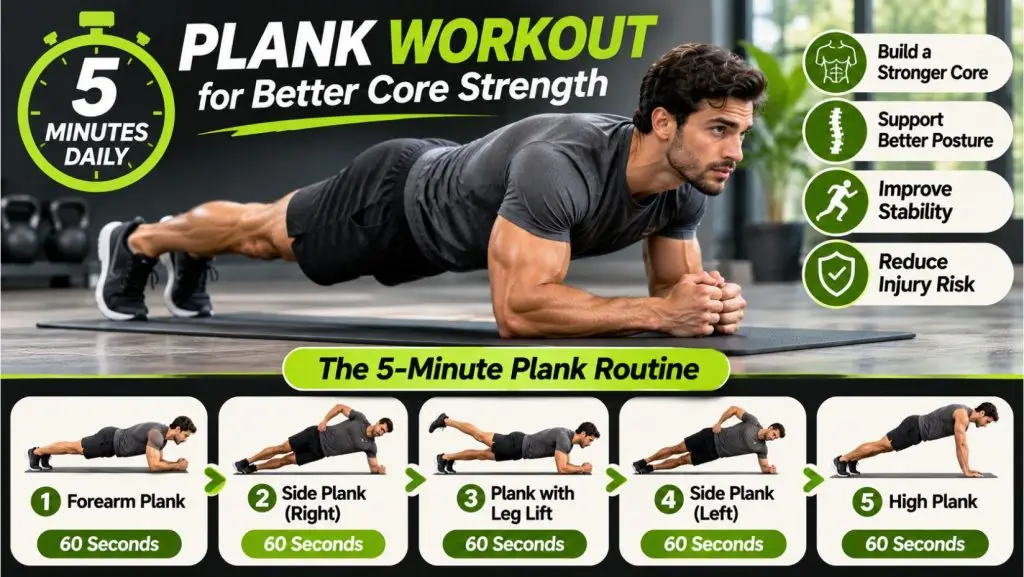
Building a stronger core does not always require expensive gym equipment or lengthy workout sessions. A simple 5 minute plank workout can help improve core muscle endurance, body stability, and overall fitness when performed consistently with proper technique.
Planks are bodyweight exercises that engage multiple muscle groups, including the abdominal muscles, back, shoulders, and glutes.
Whether you are a beginner or already follow a regular fitness routine, incorporating a short plank workout into your schedule can be a practical way to strengthen your core.
This guide explains the benefits of planking, provides a five-minute routine, and shares essential safety tips.
What Is a Plank Workout?
A plank is an isometric exercise, meaning your muscles contract while your body remains relatively still.
During a traditional plank, you support your body on your forearms and toes while maintaining a straight line from your head to your heels.
Unlike exercises that involve repeated bending or twisting, planks challenge your muscles to stabilize your spine and pelvis.
Common plank variations include:
- Forearm plank
- High plank
- Side plank
- Plank with leg lift
- Knee-supported plank
Each variation places different demands on the core and supporting muscles.
Benefits of a 5-Minute Daily Plank Workout
1. Builds Core Muscle Strength and Endurance
Planks activate several core muscles, including the rectus abdominis, transverse abdominis, and obliques.
Regular training can improve your ability to maintain stable body positions during exercise and everyday movements.
2. Supports Better Postural Control
Your core muscles help support your trunk and maintain body alignment.
Strengthening these muscles may contribute to improved postural control, although planks alone do not guarantee better posture.
3. Improves Stability and Balance
Core stability plays an important role in activities such as walking, running, lifting, and changing direction.
Plank variations can challenge your ability to resist unwanted movement.
4. Requires Minimal Equipment
One of the biggest advantages of planks is their convenience.
You only need enough floor space and a comfortable exercise mat.
5. Can Complement Other Fitness Activities
Core endurance is useful for many forms of physical activity.
Planks can be included alongside resistance training, walking, cardiovascular exercise, and mobility work.
They should not replace a balanced fitness program.
The 5-Minute Plank Workout Routine
This workout consists of five one-minute blocks. Each block includes 40 seconds of exercise followed by 20 seconds of rest or transition.
Beginners can reduce the working interval to 15–20 seconds and use the remaining time for recovery.
| Time | Exercise | Duration |
|---|---|---|
| 0:00–1:00 | Forearm Plank | 40 sec + 20 sec rest |
| 1:00–2:00 | Right Side Plank | 40 sec + 20 sec rest |
| 2:00–3:00 | Plank With Alternating Leg Lifts | 40 sec + 20 sec rest |
| 3:00–4:00 | Left Side Plank | 40 sec + 20 sec rest |
| 4:00–5:00 | High Plank | 40 sec + 20 sec rest |
The goal is controlled movement and correct alignment rather than holding each position for as long as possible.
Exercise 1: Forearm Plank
The forearm plank is a foundational core-strengthening exercise.
How to Perform
- Lie face down on an exercise mat.
- Position your elbows directly beneath your shoulders.
- Lift your body onto your forearms and toes.
- Engage your abdominal muscles and glutes.
- Keep your head, hips, and heels aligned.
- Hold the position while breathing normally.
Avoid allowing your lower back to sag or lifting your hips excessively.
Beginner modification: Keep your knees on the floor while maintaining a straight line from your head to your knees.
Exercise 2: Right Side Plank
The side plank targets the oblique muscles and challenges lateral core stability.
How to Perform
- Lie on your right side.
- Position your right elbow beneath your shoulder.
- Stack your legs or place one foot slightly in front of the other.
- Lift your hips away from the floor.
- Keep your body aligned.
- Hold the position without twisting your torso.
Beginner modification: Bend your lower knee and keep it on the floor for additional support.
Exercise 3: Plank With Alternating Leg Lifts
This variation adds a controlled movement challenge to the traditional plank.
How to Perform
- Begin in a forearm plank position.
- Engage your abdominal muscles.
- Slowly lift one foot a short distance from the floor.
- Keep your pelvis as level as possible.
- Lower your foot with control.
- Repeat with the opposite leg.
Avoid lifting your legs so high that your lower back arches.
If this movement is too challenging, perform a regular forearm plank instead.
Exercise 4: Left Side Plank
Repeat the side plank on your left side to train both sides of your trunk.
How to Perform
- Lie on your left side.
- Place your left elbow beneath your shoulder.
- Lift your hips off the floor.
- Engage your abdominal and glute muscles.
- Maintain steady breathing.
- Hold for the prescribed interval.
Use the knee-supported modification if necessary.
Exercise 5: High Plank
The high plank resembles the top position of a push-up.
It challenges your core while also engaging the shoulders and arms.
How to Perform
- Place your hands directly beneath your shoulders.
- Extend your legs behind you.
- Keep your arms straight without forcefully locking your elbows.
- Tighten your abdominal muscles.
- Maintain a neutral neck position.
- Hold while breathing steadily.
Avoid allowing your hips to drop or your shoulders to collapse.
How to Improve Your Plank Technique
Correct form is more important than the number of seconds you hold a plank.
Keep Your Spine Neutral
Maintain a comfortable, straight body position without excessive arching or rounding.
Engage Your Core
Gently brace your abdominal muscles as though preparing for a light impact.
Breathe Normally
Do not hold your breath during the exercise.
Position Your Shoulders Correctly
Keep your elbows beneath your shoulders during forearm planks and your hands beneath your shoulders during high planks.
Stop When Form Breaks Down
If your hips sag, your back begins to hurt, or you cannot maintain control, end the set and rest.
Beginner-Friendly Plank Workout Plan
If you are new to core exercises, start with shorter holds.
| Training Stage | Work Interval | Rest |
|---|---|---|
| Week 1 | 15 seconds | 45 seconds |
| Week 2 | 20 seconds | 40 seconds |
| Week 3 | 30 seconds | 30 seconds |
| Week 4 | Up to 40 seconds | 20 seconds |
These are suggested progression targets, not requirements.
Advance only when you can complete the exercises comfortably with good technique.
You may also repeat the same training stage for longer than one week.
Should You Do Planks Every Day?
A short plank routine may be manageable for some healthy adults, but daily training is not necessary to improve core strength.
Muscles benefit from recovery, particularly after challenging sessions.
Beginners may prefer performing the routine three or four times per week before increasing frequency.
If you experience persistent soreness, fatigue, or discomfort, take additional rest days.
Consistency and exercise quality matter more than completing a plank workout every single day.
Common Plank Workout Mistakes
Holding Your Breath
Breath-holding can unnecessarily increase physical strain.
Continue breathing throughout the exercise.
Allowing Your Hips to Sag
Sagging hips can place unwanted stress on the lower back.
Shorten the hold or use a modified plank if you cannot maintain alignment.
Raising Your Hips Too High
Excessively elevated hips can reduce the intended challenge to your core.
Maintain a controlled body position.
Ignoring Shoulder Discomfort
Planks place weight through the shoulders and wrists.
Choose a modified variation if you experience discomfort.
Focusing Only on Duration
Holding a poorly performed plank for several minutes is not necessarily better than completing shorter, controlled sets.
Can a Daily Plank Workout Reduce Belly Fat?
Planks strengthen and challenge the abdominal muscles, but they do not specifically burn fat from the stomach.
Spot reduction—the idea that exercising one body area selectively removes fat from that location—is not supported by strong evidence.
Changes in body fat depend on broader factors, including energy balance, physical activity, nutrition, and individual characteristics.
For general fitness, combine core exercises with resistance training, cardiovascular activity, and balanced eating habits.
Who Should Be Careful With Plank Exercises?
People with certain medical conditions or injuries may need to modify or avoid planks.
Seek individualized guidance if you have:
- Recent abdominal or spinal surgery
- Significant back pain
- Wrist or shoulder injuries
- Pregnancy-related exercise concerns
- Conditions that make weight-bearing exercise difficult
Stop exercising if you experience sharp pain, dizziness, unusual breathlessness, or other concerning symptoms.
Tips for Staying Consistent With Your Core Workout
Choose a convenient time for your routine and focus on making it manageable.
You might perform your plank workout after a warm-up, during a gym session, or as part of a short home exercise routine.
Track your progress by recording how long you can maintain correct form.
As your endurance improves, gradually increase the challenge rather than rushing toward longer holds.
Remember to include exercises for other muscle groups as part of a balanced fitness program.
Conclusion
A 5 minute plank workout can be a convenient way to develop core endurance, improve stability, and support overall fitness.
By combining forearm planks, side planks, controlled leg lifts, and high planks, you can challenge several muscle groups without specialized equipment.
Start with manageable intervals, prioritize proper technique, and allow adequate recovery.
Over time, a consistent and appropriately challenging routine can contribute to a stronger, more stable core.
Frequently Asked Questions
Is a five-minute plank workout effective?
A five-minute routine can help improve core muscle endurance, particularly for beginners. Results depend on exercise quality, consistency, and progression.
Can I do planks every day?
Some people can tolerate short daily plank sessions, but rest days may be beneficial. Beginners should gradually build training frequency.
How long should beginners hold a plank?
Beginners can start with 10–20-second holds and increase the duration as their technique and endurance improve.
Do planks help improve posture?
Planks strengthen muscles involved in trunk stability and may support postural control, but posture is influenced by several factors.
Can planks give you visible abs?
Planks can strengthen abdominal muscles, but visible abdominal definition also depends on body composition and individual factors.
Are planks better than crunches?
Both exercises train abdominal muscles differently. Neither is universally better, and a balanced core routine can include multiple movement patterns.
Suggested References
- American Council on Exercise – Core Exercise and Plank Technique
- American College of Sports Medicine – Resistance Training Guidance
- Centers for Disease Control and Prevention – Physical Activity Guidelines for Adults
- National Strength and Conditioning Association – Core Stability Training
Fitness disclaimer: This article provides general exercise education and does not replace personalized advice from a qualified healthcare professional or fitness trainer.