
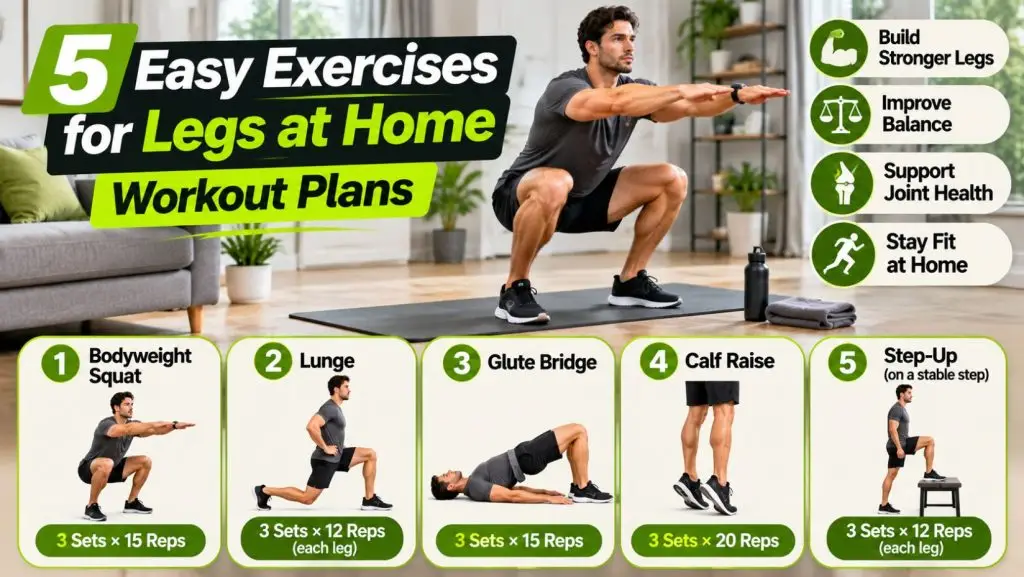
You do not need an expensive gym membership or complicated equipment to strengthen your legs. With a little space and a consistent routine, you can perform effective leg exercises at home that target your thighs, glutes, calves, and other lower-body muscles.
Strong legs are important for everyday activities such as walking, climbing stairs, lifting objects, and maintaining balance.
Whether you are starting your fitness journey or looking for a convenient home workout, these five beginner-friendly exercises can help you develop lower-body strength and muscular endurance.
This guide explains how to perform each exercise, provides a practical workout schedule, and shares tips for progressing safely.
Why Are Leg Exercises Important?
Your lower body contains several large muscle groups that support movement and stability.
Regular leg-strengthening exercises can provide several benefits.
Build Lower-Body Strength
Resistance exercises challenge your quadriceps, hamstrings, glutes, and calves.
Over time, consistent training can improve muscular strength and endurance.
Improve Functional Fitness
Strong leg muscles support common activities such as standing from a chair, walking uphill, and climbing stairs.
Support Balance and Stability
Exercises that involve standing and shifting weight can help develop coordination and balance.
Maintain Healthy Bones
Weight-bearing and resistance exercises can support bone health when performed appropriately.
Make Exercise More Convenient
Home workouts reduce the need for specialized equipment and can be adapted to different fitness levels.
1. Bodyweight Squats
Bodyweight squats are among the most practical exercises for strengthening your legs at home.
They primarily target the quadriceps and glutes while also engaging the hamstrings and core.
How to Perform Bodyweight Squats
- Stand with your feet approximately shoulder-width apart.
- Keep your chest comfortably upright.
- Bend your knees and hips as though sitting into a chair.
- Lower yourself only as far as you can while maintaining control.
- Push through your feet to return to standing.
- Repeat at a comfortable pace.
Recommended starting target: 2–3 sets of 8–15 repetitions.
Beginner Modification
Use a sturdy chair behind you and practice sitting down and standing up with control.
Avoid forcing a deep squat if your mobility does not comfortably allow it.
2. Reverse Lunges
Reverse lunges strengthen the quadriceps, glutes, and supporting muscles involved in balance.
Stepping backward may feel more manageable than forward lunges for some beginners.
How to Perform Reverse Lunges
- Stand upright with your feet hip-width apart.
- Step backward with one foot.
- Bend both knees while keeping your torso controlled.
- Lower your body toward the floor without forcing your rear knee to touch it.
- Push through your front foot to return to standing.
- Repeat on the opposite side.
Recommended starting target: 2–3 sets of 8–12 repetitions per leg.
Beginner Modification
Hold a stable chair or countertop for balance.
If lunges cause discomfort, substitute supported split squats or chair sit-to-stands.
3. Glute Bridges
Glute bridges are floor-based exercises that primarily target the gluteal muscles.
They also involve the hamstrings and trunk stabilizers.
How to Perform Glute Bridges
- Lie on your back with your knees bent.
- Place your feet flat on the floor, approximately hip-width apart.
- Keep your arms relaxed beside your body.
- Gently engage your abdominal muscles.
- Press through your feet and lift your hips.
- Pause briefly at the top without excessively arching your back.
- Lower your hips with control.
Recommended starting target: 2–3 sets of 10–15 repetitions.
Beginner Modification
Lift your hips through a smaller, comfortable range of motion.
Focus on smooth movement rather than lifting as high as possible.
4. Standing Calf Raises
Calf raises target the muscles at the back of your lower legs.
These muscles play an important role in walking, climbing stairs, and pushing off the ground.
How to Perform Standing Calf Raises
- Stand upright with your feet approximately hip-width apart.
- Hold a stable surface if you need balance support.
- Slowly raise your heels off the floor.
- Pause briefly at the top.
- Lower your heels with control.
- Repeat without bouncing.
Recommended starting target: 2–3 sets of 12–20 repetitions.
Beginner Modification
Keep both hands on a stable countertop and use a comfortable movement range.
Avoid performing calf raises on an elevated step until you have adequate balance and control.
5. Step-Ups
Step-ups are a functional exercise that strengthens the quadriceps and glutes.
They resemble everyday movements such as climbing stairs.
How to Perform Step-Ups
- Choose a low, stable step designed to support your body weight.
- Place one foot firmly on the step.
- Push through that foot to raise your body.
- Bring your other foot onto the step if comfortable.
- Step down slowly and with control.
- Repeat before changing legs.
Recommended starting target: 2–3 sets of 8–12 repetitions per leg.
Beginner Modification
Use a low step with a secure handrail nearby.
Never use an unstable chair, rolling stool, or slippery surface for step-ups.
Easy Home Leg Workout Plan for Beginners
You can combine all five exercises into a simple lower-body routine.
| Exercise | Sets | Repetitions |
|---|---|---|
| Bodyweight Squats | 2–3 | 8–15 |
| Reverse Lunges | 2–3 | 8–12 per leg |
| Glute Bridges | 2–3 | 10–15 |
| Standing Calf Raises | 2–3 | 12–20 |
| Step-Ups | 2–3 | 8–12 per leg |
Rest approximately 60–90 seconds between sets, or longer if needed.
Begin with two sets per exercise if you are new to strength training.
Weekly Home Leg Workout Schedule
Training your legs two or three times per week can be an effective starting point.
| Day | Activity |
|---|---|
| Monday | Home leg workout |
| Tuesday | Walking or light activity |
| Wednesday | Rest or upper-body training |
| Thursday | Home leg workout |
| Friday | Gentle mobility or walking |
| Saturday | Optional light full-body activity |
| Sunday | Rest |
Allow adequate recovery between challenging leg sessions.
Beginners may find two weekly sessions sufficient while developing strength and exercise confidence.
Warm-Up Before Your Leg Workout
A short warm-up prepares your muscles and joints for physical activity.
Spend approximately five minutes performing gentle movements such as:
- Marching in place
- Comfortable walking
- Controlled hip movements
- Easy bodyweight squats
- Gentle ankle movements
Gradually increase your movement intensity rather than immediately beginning difficult exercises.
How to Make Your Home Leg Exercises More Effective
Focus on Proper Technique
Good exercise technique helps you target the intended muscles while reducing unnecessary strain.
Avoid rushing repetitions.
Increase the Challenge Gradually
As exercises become easier, you can increase repetitions, add a set, or use suitable resistance equipment.
Use Controlled Movements
Move steadily through a comfortable range of motion.
Avoid bouncing or using momentum to complete repetitions.
Include Recovery Days
Muscles need time to recover from challenging training.
Schedule rest days according to your experience and exercise intensity.
Maintain Balanced Nutrition
Adequate energy, protein, and other nutrients support normal recovery and muscle adaptation.
Can You Build Leg Muscle Without Gym Equipment?
Yes. Bodyweight exercises can improve muscular strength and endurance, particularly for beginners.
As your strength increases, you may need additional resistance to continue making substantial gains.
Resistance bands, appropriately weighted dumbbells, or more challenging exercise variations can help provide progressive overload.
However, increasing difficulty should never come at the expense of safe technique.
Common Mistakes to Avoid During Home Leg Workouts
Skipping the Warm-Up
Starting difficult exercises without preparation may make movements feel uncomfortable.
Begin with gentle activity.
Performing Too Many Repetitions
More repetitions are not always better.
Choose a manageable workload that allows you to maintain control.
Ignoring Joint Pain
Muscle effort and mild post-exercise soreness can be normal, but sharp or worsening joint pain should not be ignored.
Stop the exercise and seek professional advice if necessary.
Using Unstable Furniture
Chairs, stools, and household objects are not always suitable exercise equipment.
Use stable support surfaces and avoid unnecessary fall risks.
Training Without Rest
Excessive training can lead to fatigue and reduced performance.
Allow adequate recovery between challenging sessions.
How Long Does It Take to Strengthen Your Legs?
Some beginners may notice improvements in exercise control and muscular endurance within several weeks.
Larger strength and muscle changes generally require consistent training over a longer period.
Results vary depending on training intensity, nutrition, recovery, age, and previous exercise experience.
Focus on gradual improvements rather than expecting dramatic changes after only a few workouts.
Who Should Modify These Leg Exercises?
People with knee, hip, ankle, or back problems may need modified movements.
Individuals recovering from surgery, managing balance difficulties, or living with medical conditions should seek individualized guidance before starting a new exercise program.
Stop exercising if you experience sharp pain, severe dizziness, chest discomfort, or unusual shortness of breath.
Conclusion
These five leg exercises at home offer a convenient way to strengthen your lower body without requiring a gym membership.
Bodyweight squats, reverse lunges, glute bridges, calf raises, and step-ups target different muscles while supporting everyday movement and functional fitness.
Start with manageable sets and repetitions, prioritize correct technique, and gradually increase the challenge as your strength improves.
With consistency and adequate recovery, a simple home workout routine can become an effective part of a balanced fitness lifestyle.
Frequently Asked Questions
What are the best leg exercises at home for beginners?
Bodyweight squats, supported lunges, glute bridges, calf raises, and low step-ups are useful beginner-friendly options.
Can I strengthen my legs without weights?
Yes. Bodyweight exercises can improve leg strength and endurance, especially for beginners. Additional resistance may become useful as you progress.
How often should I do leg exercises at home?
Two or three sessions per week can be appropriate for many adults, depending on intensity, experience, and recovery.
Do squats help strengthen your legs?
Yes. Squats primarily train the quadriceps and glutes while also engaging other lower-body and trunk muscles.
How long should a home leg workout last?
A beginner workout may take approximately 20–35 minutes, depending on the number of sets, rest periods, and warm-up duration.
Are leg exercises suitable for older adults?
Many leg-strengthening exercises can be adapted for older adults. Appropriate modifications and balance support may be necessary.
Suggested References
- CDC – Physical Activity Basics for Adults
- WHO – Physical Activity
- American College of Sports Medicine – Resistance Training Recommendations
- American Council on Exercise – Lower-Body Exercise Guidance
Fitness disclaimer: This article provides general exercise information and is not a substitute for individualized medical advice or professional fitness instruction.